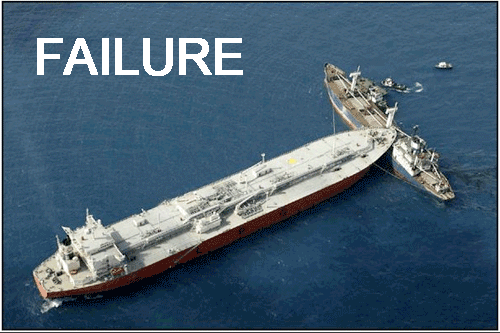
Crossing Tokyo Bay

failure-at-sea

One of the goals of a true leader is to be the Keeper and the Promoter of the Vision. As a leader you determine where the organization is going and you steer the team through often stormy seas, always keeping an eye on the far distant horizon, rallying the troops with enthusiastic descriptions of the Glorious Future that lies ahead.

A compelling image, it’s true. Being Keeper of the Vision is important — but, to borrow from Stephen Covey, what about those times when the urgent things seem to completely subsume the important things? Are there times in an organization when the lofty language of vision takes a back seat to the terse commands of immediate danger? As every leader knows, the answer is “Absolutely.”

Back in my U.S. Navy days when we were sailing across the wide Pacific Ocean, we typically had our radar set to its maximum range — about 40 miles in those days. I remember many times when we were sailing on the same course all day long, seeing another distant and harmless ship here and there, traversing the calm seas under the breezy sunshine at our blistering cruising speed of around 22 knots. At times like that it was easy for the captain to maintain the Vision — we knew our ultimate destination and we were on a good course and speed to get there without interruption. Sometimes your organization is like that: nothing but fair winds and following seas, as the mariners used to say. Being a leader at times like that is a calm and lofty experience indeed.

But one time we sailed into Tokyo Bay, heading for the Japanese port of Yokosuka. I had never in my life seen so many ships, boats, barges, tugs, fishing boats and random water craft in one concentrated place in my life — like a floating Interstate 5 at rush hour! At times like that you forget about talk of your long-range “vision.” You also forget about the luxury of gazing across those wide open seas toward the far horizon. And that 40-mile radar range? You have to shift your thinking drastically, reducing that radar sweep down to about 2,000 yards, just to avoid hitting something or being hit. (Old Navy saying: “A collision at sea can ruin your whole day.”) Experiences like that are when a leader shows his/her true mettle. Can you avoid your natural impulse to panic? Can you, as Kipling said, keep your head when those around you are losing theirs? Stressful times like that transit of Tokyo Bay reveal a lot more about the character of the captain of a ship — or the leader of an organization — than peaceful days sailing under the open sunshine of the breezy, broad Pacific.

Is your organization on the wide open sea, with your steady hand guiding the group toward your Vision, full speed ahead? Or are you in Tokyo Bay with the potential for disaster imminent, reacting to the barrage of danger signs all around, doing your best to arrive safely at the dock without a collision? Yes, the lofty language of vision is important — but so is the steady confidence of the leader who is competent and sure-handed under stress. Here’s a salute to those leaders who possess the ability to thrive in both the calm and the crisis.
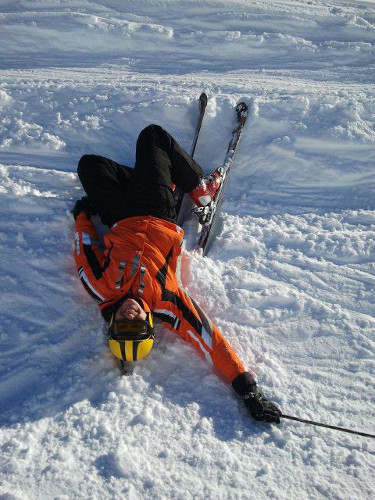
Are You Staring At Your Ski Tips?

fallen-skier           I used to ski — snow ski, that is. I learned the basics of good old downhill skiing in 9th grade on the mushy slopes of Snoqualmie Summit, riding the ski bus once a week from the Washington Athletic Club. Back in those days (DANGER: NOSTALGIA ALERT!) we used to have to start tying our ski boots at about North Bend because it took so long. Yes, I said “tying.” Boots came with laces: only experienced, moneyed skiers had boots with buckles. Our skis had cable bindings, too, for that matter…but I digress.

Yes, I used to ski, and although I stopped skiing decades ago there is one lesson that our instructor (I think his name was Thor) kept drumming into us: don’t focus on the tips of your skis! As beginners that’s precisely what we tended to do. We would traverse the slope as far as we good, then make a clumsy, panicky turn and traverse back the other direction, all the while with our eyes riveted to the tips of our skis, as if that would somehow keep us vertical. As we started to gain a bit of momentum, still staring at those ski tips, we would invariably run smack into the side of a mogul and go tumbling, often popping our cable bindings in the process.

So Thor kept reminding us: don’t stare at the tips of your skis! Instead focus your attention down the slope. Not only does it help you point your weight in the right direction — it also helps you see those moguls coming up well ahead of time, so you can actually maneuver to avoid them. This was a revelation! Not only could we anticipate obstacles, we could — amazing, but true! — keep from running into them! By staring fixedly and fearfully at our ski tips we only ensured that, by the time we saw the mogul, we were milliseconds from running into it — too late to react. Looking down the slope felt counterintuitive at first, but it proved to be essential to generating any sort of rhythm on the way down the mountain. Once I had the nerve to try it, prying my eyes from those ski tips and gazing at the slope ahead, I finally started learning how to ski. (Not great, you understand, but much, much better.)

The metaphor for us seems clear. If we try to plow through our day staring at the tips of our proverbial skis, then all we ever seem to do is to react. The obstacle (a task, a deadline, a project, a problem) looms suddenly before us, completely unexpected, and our response is clumsy, awkward, unfruitful, maybe even disastrous. But as we start to lift our eyes and learn to gaze ahead down the slope, we begin to see those hazards coming. We become proactive — we anticipate. And as a result, we handle the problems better. We develop some satisfying rhythm, even some grace. And we don’t fall down quite so much!

Does every problem seem to knock you down, sprawling in the snow? Maybe you need to listen to Thor: “Stop looking at the tips of your skis!”

Efficiency ≠ Effectiveness!

I spent quite a lot of my career in radio advertising. It used to be true, and I presume it still is, that the chief means an advertiser uses to determine how much he or she is willing to pay for radio time is a tool called “Cost Efficiency.” The precise metrics and parameters may change but the concept remains the same: the buyer sets a Cost Efficiency goal which is 100% based on audience ratings — answering the basic question, “How much am I willing to pay to reach this audience?” Radio stations then compete to meet that goal: either you’re sufficiently Cost Efficient and you make the buy, or you’re not and you don’t. No hard feelings. The numbers don’t lie.

Well…they may not lie, but they do exaggerate.

Cost Efficiency only works, in my experience, for three reasons. First, it’s fairly easy to teach someone to put together a buy using some pre-determined Cost Efficiency goal as the standard. Second, a Cost Efficiency goal at least creates a level playing field, evaluating all contestants using a common standard — the device may be flawed but it’s consistent. And third, I suspect most advertisers don’t really know if their advertising actually works or not. J.C. Penney once made the famous statement, “I know that half my advertising dollars are wasted — I just don’t know which half.” People thought he was kidding, but I’m convinced he meant it. Drawing a straight line between your advertising and your cash register is a tricky business!

In other words, an advertising buy may look good on paper — it’s highly Cost Efficient — but it may not accomplish the advertiser’s goal very well at all. It’s not very Cost Effective.

I think there’s an underlying mistake we tend to make frequently in our culture — we confuse efficiency with effectiveness. The two ideas are far from synonymous. In your workplace, if you’re a manager, you may be tempted to make decisions based entirely on efficiency only to discover that what looked good on paper actually results in frustration, fatigue and burnout. Your plans aren’t effective at all! If you’re a parent, you may think scheduling your family time “efficiently” is the highest goal, only to experience a growing emotional disconnect between you and your kids, or you and your spouse. Important concepts like friendship, love, teamwork and commitment simply can’t be done “efficiently.” The process of cultivating the things that are most important in life  — our relationships — is inherently messy, ragged and inefficient. (Speaking of messy, is there an “efficient” way to raise kids, for example?) You could almost say, when it comes to relationships, that Efficiency is frequently the enemy of Effectiveness.

Sometimes as fundraisers or salespeople we have a choice: we can focus on what’s Efficient or we can emphasize what’s Effective. It’s efficient to send out the same letter to 500 recipients — it’s effective to hand-write 20 personal notes. It’s efficient to send 300 eblasts — it’s effective to make a dozen personal phone calls. Each can be important, and at times those ideas of efficiency and effectiveness can mesh nicely — but at those times where they don’t, I suggest that it’s better to be effective than efficient. What do you think?

Of Football and God

Okay, let’s REALLY stretch this metaphor…

Yesterday we were at my son’s house watching the Super Bowl. Needless to say, for Seattle fans the game was the kind of cathartic, exhilarating moment that only comes after long years of drought, a word which accurately describes the Seattle sports scene when it comes to major sports championships. At one point I was holding my infant grandson when something terrific (for the Seahawks, of course) happened in the game, and I reacted like any success-starved Seahawk fan would react: I went nuts.

Of course, my shouts of glee totally freaked out my grandson who immediately started crying. Naturally I felt awful, trying to explain to the little guy that Grandpa was happy, not mad, but it was no use. Mommy had to take him away for some calming-down time. After that my son and I did most of our cheering (and fortunately for the Seahawks there was plenty to cheer about) in pantomime. We were highly enthusiastic but relatively silent. Relatively.

Reflecting on the episode today I realized that it would have been no use trying to explain to my infant grandson the finer points of football, and what it was that made Grandpa leap up and holler at the TV set. To my grandson’s ear, I probably sounded angry, agitated, threatening — one minute he was calmly bouncing in Grandpa’s arms, and the next minute this large, loud man is yelling in his ear and stomping around the room! Someday he’ll get it, but not yesterday.

And, I thought, isn’t that just a little bit analogous to the relationship between us and God? Sometimes God moves and we just don’t get it. We don’t understand His actions, His emotions, His perspective. One minute we’re bouncing happily and calmly in God’s arms, and the next minute our world is upset and our tranquility vanishes, and God suddenly seems vindictive or angry. Something is happening that we in our spiritual infancy just don’t get, and no matter how much He might try to explain it, our tears of agitation and fear do not quickly subside.

There’s an old saying that comes in handy at times like that: “When you can’t trace God’s hand, trust His heart.” My grandson is really little and doesn’t know my heart of love for him very well yet — but as adults, we actually do know quite a lot about the heart of God, I think. So next time something God does triggers fear in me, maybe I’ll remember the Super Bowl and calm down. Maybe God isn’t mad at all — He’s just cheering me on!