Crossing Tokyo Bay

failure-at-sea

One of the goals of a true leader is to be the Keeper and the Promoter of the Vision. As a leader you determine where the organization is going and you steer the team through often stormy seas, always keeping an eye on the far distant horizon, rallying the troops with enthusiastic descriptions of the Glorious Future that lies ahead.

A compelling image, it’s true. Being Keeper of the Vision is important — but, to borrow from Stephen Covey, what about those times when the urgent things seem to completely subsume the important things? Are there times in an organization when the lofty language of vision takes a back seat to the terse commands of immediate danger? As every leader knows, the answer is “Absolutely.”

Back in my U.S. Navy days when we were sailing across the wide Pacific Ocean, we typically had our radar set to its maximum range — about 40 miles in those days. I remember many times when we were sailing on the same course all day long, seeing another distant and harmless ship here and there, traversing the calm seas under the breezy sunshine at our blistering cruising speed of around 22 knots. At times like that it was easy for the captain to maintain the Vision — we knew our ultimate destination and we were on a good course and speed to get there without interruption. Sometimes your organization is like that: nothing but fair winds and following seas, as the mariners used to say. Being a leader at times like that is a calm and lofty experience indeed.

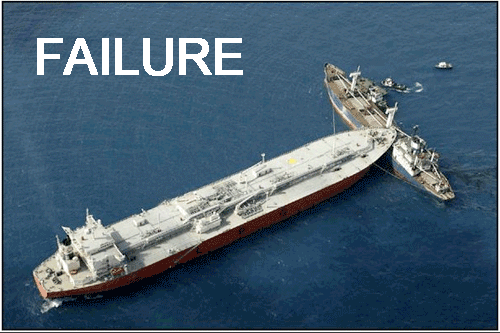
But one time we sailed into Tokyo Bay, heading for the Japanese port of Yokosuka. I had never in my life seen so many ships, boats, barges, tugs, fishing boats and random water craft in one concentrated place in my life — like a floating Interstate 5 at rush hour! At times like that you forget about talk of your long-range “vision.” You also forget about the luxury of gazing across those wide open seas toward the far horizon. And that 40-mile radar range? You have to shift your thinking drastically, reducing that radar sweep down to about 2,000 yards, just to avoid hitting something or being hit. (Old Navy saying: “A collision at sea can ruin your whole day.”) Experiences like that are when a leader shows his/her true mettle. Can you avoid your natural impulse to panic? Can you, as Kipling said, keep your head when those around you are losing theirs? Stressful times like that transit of Tokyo Bay reveal a lot more about the character of the captain of a ship — or the leader of an organization — than peaceful days sailing under the open sunshine of the breezy, broad Pacific.

Is your organization on the wide open sea, with your steady hand guiding the group toward your Vision, full speed ahead? Or are you in Tokyo Bay with the potential for disaster imminent, reacting to the barrage of danger signs all around, doing your best to arrive safely at the dock without a collision? Yes, the lofty language of vision is important — but so is the steady confidence of the leader who is competent and sure-handed under stress. Here’s a salute to those leaders who possess the ability to thrive in both the calm and the crisis.

A Belated Thanks (and an Apology) to the Boss

A note to all my past bosses, supervisors and managers: thank you. And, um, sorry about that.

I was reflecting the other day on the string of jobs I’ve had and the remarkable variety of men and women I’ve reported to. It all began with Dick at the Thriftway. Then there was Harry at the gas station. Then the Navy with five commanding officers, three executive officers and a passel of department heads. Then there was Greg, and then Bill, and Dana and Edie and Mac and Susan and Bob and Dick and Paul and Rick and Stan and Joe and Jim and Tim and Bob and Jane and Mark and Dave. Whew! I probably left somebody out, but you get the idea.

Two thoughts occurred to me as I considered this list. First, each one of these men and women really wanted to do a good job. Whether or not I happened (in my vast wisdom) to agree at the time with their approach and their philosphy of leadership doesn’t matter: without exception these were good people who worked hard, took a lot of stress home with them at night, and tried to fight the good fight. Not a bum in the bunch. So consider this a collective “Thank you” to bosses past and present.

The second thought is more convicting. Honest self-appraisal time: how often when I worked for these folks was I part of the problem and not part of the solution? Did I grouse more than I should have, even occasionally? Did I ever fuel the fires of complaint, negativity, or mistrust? Did I leave one job or another prematurely, forcing my then-boss to deal with the frustration of employee turnover? (Edie and Mac and Susan, I’m thinking about you here…) I’m not saying I would go back and change things even if I could — I’m simply wondering if I could have made my boss’s life easier by doing my work better and complaining less. So consider this a collective “My bad” for the times I made the boss’s life more difficult than I might have.

He who pursues righteousness and love finds life, prosperity and honor says Proverbs 21:21. Translation: my agenda isn’t Priority One. Behaving in a way that’s honorable, loving and diligent — that’s the goal…whether the boss notices it or not! So if this applies, take it to heart. And next time you get the chance, say thanks to the boss. He/she will appreciate it — I guarantee it.

The Unqualified Compliment

Admit it — doesn’t it feel good to receive a word of encouragement? I’m thinking particularly of the workplace here. I don’t know about you but I derive quite a bit of personal satisfaction, not to mention a sense of job security (maybe too much, come to think of it) when I receive a compliment or an encouraging word from the boss. Conversely, when the boss never says anything encouraging, I find myself plagued with self-doubt. Am I not measuring up? Does he or she not like me anymore? Neurotic? Maybe…but I strongly suspect I’m not the only one. You know who you are!

Somewhere between the sound of silence from the boss and the pleasant and encouraging word of affirmation lies what I call the Qualified Compliment. I had a boss once who was the master of the Qualified Compliment — he simply couldn’t bring himself to say something encouraging without adding a stinger at the end. Examples:

  • “Nice month in January! Way to go! Of course, the rest of the quarter doesn’t look so hot…”
  • “Good work on the McDonald’s buy — nice piece of business! Why didn’t we get on Fred Meyer?”
  • “Looks like Bill is really coming around — you’re doing a good job with him! But Anne is really slipping…what’s going wrong there?”

Just once, I used to think, can’t you say something encouraging and then leave it there? I guess he feared I would get complacent…but actually his backhanded criticism sowed seeds of self-doubt. Not healthy.

Managers, here’s a thought: try giving one of your team members a compliment without qualification: an Unqualified Compliment! Then see what happens. I think you have some subordinates who will REALLY appreciate it!

The Four i’s of Poor Leadership

Leadership. Is there any topic concerning which more words have been written, more speeches given, more consulting fees generated? At last count there are presently over three billion books in print about leadership. (Okay, I made that up…but it must be a lot.)

Like you, I’ve worked for some terrific leaders — and I’ve worked for some who were, um, not so terrific. Talking about this with some friends this morning, we came up with at least four traits that we think render a leader ineffective. See if you agree with the Four i’s of Poor Leadership.

1. A poor leader is indecisive. This one stings a bit because I know in my past roles as a leader I have been guilty of stalling, analyzing, and debating some obvious decisions far past their expiration date. Those who look to you for leadership need you to be decisive. Remember, not to decide is to decide!

2. A poor leader is impulsive. This ready-fire-aim trait can unsettle everyone around you, as the boss’s project du jour suddenly sweeps aside all the really important priorities. If indecisiveness is at one end of the negativity scale, impulsiveness is probably at the other.

3. A poor leader is insulated. Leaders can hide behind their desks, their doors, their walls, their circle of self-serving advisors, and not listen to the inconvenient truth that those not on the “inside” are dying to disclose. This goes far beyond the world of business: how many politicians and religious leaders are brought low because they insulate themselves from the facts and refuse to be accountable?

4. A poor leader is insecure. I’m not talking about the brash pseudo-security that comes from an overpowering personality — that’s not true security. I mean the inner strength that says, “I know who I am. I know what I believe. And I am not at the mercy of the opinions of those around me.” (Personally I think that inner strength comes from our relationship with God.) Insecurity drives some leaders to feel they always have to be Mr. or Ms. Nice Guy, while others conclude they have to be Ms. or Mr. Dictator, constantly demanding my respect. Either way, I think insecurity is the at root of the problem.

So there are my Four i’s of Poor Leadership. What do you think? Any you’d like to add?